Albert Hock
The Master Butchers Singing ClubAlbert Hock, known as Sheriff Hock, is Argus’s sheriff: a precise, painstaking public official whose careful investigation of the deaths in Roy Watzka’s cellar stands in sharp contrast to his inability to accept Clarisse Strub’s rejection. He listens closely to Delphine Watzka and Cyprian Lazarre, documents their account, and takes charge of the investigation, but his long pursuit of Clarisse has made his private life a source of pity and uneasy humor in town. The contrast matters: Hock can attend to evidence with patience, yet when Clarisse speaks of his behavior, he is a man who hears what he wants.
Identity and Public Bearing
Hock’s physical presence combines delicacy and bulk. His fine features sit amid rounded cheeks and chins; his hair is sparse on top but vigorous in his beard, while his mouth is described as grubby and childlike. The description makes him difficult to reduce to the authority of his office: he is both imposing and faintly ridiculous. Yet his manner of conducting official business is exact. When Roy arrives agitated, demanding that the bodies be removed, Hock does not match his outrage. He leans back from the desk and becomes still, regarding Roy with patient contempt.
That stillness accompanies a striking capacity for attention. At his desk, Hock draws a brown paper blotter close, opens a moss-green record book, and prepares to write. His fingers are described as beautiful, and his actions are methodical: he invites Delphine and Cyprian to begin, then waits as they reconstruct what happened. Rather than hurry them through a general account, he gives them room to find accurate descriptions of each step.
Investigation of the Cellar Deaths
The report begins with Roy’s demand that the bodies be taken out of his cellar. Cyprian recognizes that Roy’s accusatory manner is unlikely to help and quietly urges him to sit down and be quiet so the events can be explained from the beginning. Delphine and Cyprian then alternate in recounting what they know. Hock records their account with such care that his questions and patience draw out precise details: the time of day, the available light, the strength of the odor, their theories, and their concern for Roy. By the time they finish, the witnesses are exhausted, and the labor of describing what happened feels monumental.
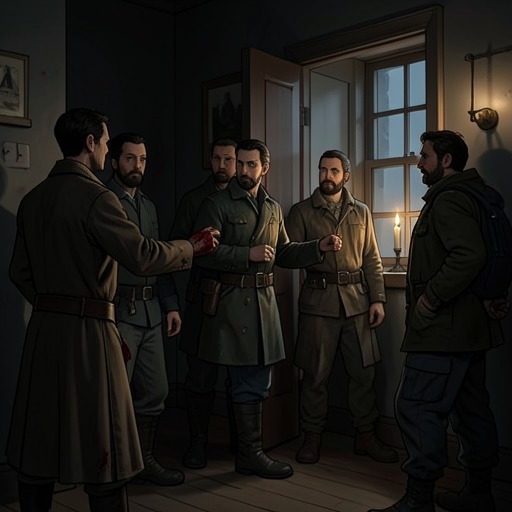
Hock proceeds to the investigation rather than treating the account as its conclusion. His office contains the practical equipment of his position: a pistol, measuring tapes, traffic flags, notebooks, files, and rifles. He selects what he needs, leaves his deputy a lengthy note, and takes Roy with him in the car. Delphine and Cyprian follow. At the house, Hock wears a quarantine mask, moves through the rooms, opens the pantry hatch, and makes notes before stepping outside. His pause in the yard leaves it unclear whether he is managing his stomach or gathering his thoughts.
He tells Roy that the house cannot yet be reoccupied. Before allowing him back in, Hock must interview the other guests who attended on the fatal night. He also informs Delphine and Cyprian that, because they have already seen the scene and may have destroyed evidence of foul play, they must remain in town as potential witnesses. Both agree. The decision extends the consequences of their discovery: Roy cannot simply return to his home, and Delphine and Cyprian cannot leave town while the investigation is pending.
Clarisse Strub and the Limits of His Attention
Hock’s private pursuit of Clarisse Strub sharply complicates the careful authority he displays in the investigation. Before becoming sheriff, he had performed as King Henry VIII and Falstaff, roles remembered in town. His infatuation with Clarisse is equally well known: he has pursued her for years and written poems of self-pity, while she angrily despises him. What was once a familiar subject of jokes becomes more troubling because the object of his attention does not share it.
Clarisse describes a late-night visit in which Hock stood on her porch, making conversation and pretending they shared a secret. She shut the door in his face. He then came close enough for her to hear him whisper through it a threat borrowed from the story of the three little pigs: he would huff and puff and blow her house down. Clarisse says that nothing she does changes his interpretation; he turns her actions around to hear what he wants. Her account recasts the sheriff’s persistence not as a harmless romantic joke but as a boundary-crossing pursuit that makes her feel powerless.
The contrast with Hock’s official conduct is pointed. In the cellar investigation, he patiently records the details other people provide and lets their careful testimony shape the record. With Clarisse, by contrast, she says he refuses to receive her refusal on its own terms. His attentiveness is real, but it is not universal: the man capable of listening closely in an official inquiry can be willfully deaf when his own desire is involved.
Narrative Role and Significance
Hock’s investigation gives the discovery of the cellar deaths a civic and procedural aftermath. His record book, equipment, interviews, and witness restrictions mark the transition from private shock to an inquiry that involves the town and its authorities. He does not resolve the mystery in the scenes shown; instead, he establishes what must happen next and keeps the principal witnesses in Argus while he investigates.
At the same time, Hock’s attachment to Clarisse links public authority to private danger. The town knows of his pursuit and has turned it into a stale joke, but Clarisse’s account makes clear the cost of that public normalization. Hock is neither merely comic nor defined only by his office: he is a capable investigator whose precision coexists with a personal fixation that prevents him from respecting another person’s clear rejection. The disparity between these sides of him is central to his significance in the narrative.